Key takeaways
- LFGB testing for silicone is generally stricter than FDA requirements, including a volatile organic matter limit.
- Platinum-cured silicone has fewer by-products and less odour than peroxide-cured silicone and is preferred for baby items.
- A simple pinch-and-twist test can reveal fillers, but lab testing is the only real proof.
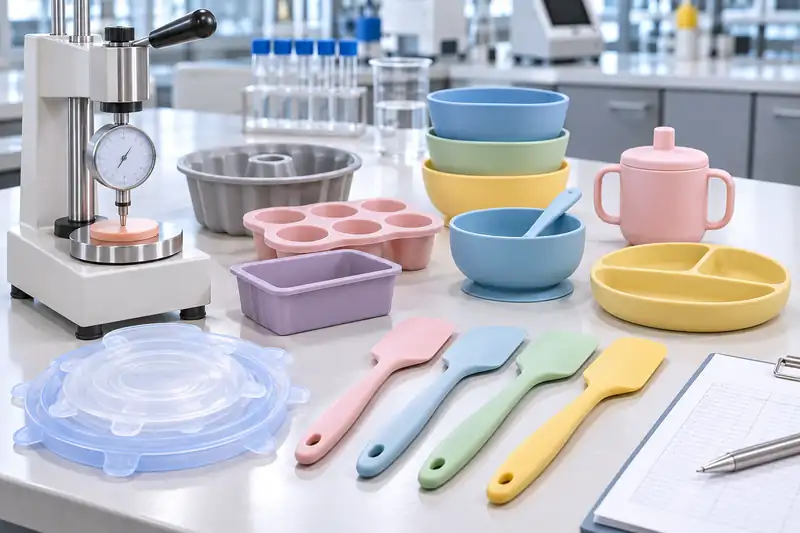
Silicone has become the default material for bakeware, utensils, baby feeding and air fryer liners. But “food-grade silicone” covers a wide range of quality. Here is how to specify it so that the products you sell are safe, odour-free and durable.
How silicone kitchenware is made
Most kitchen silicone is compression-moulded: raw silicone compound is mixed with colour masterbatch and a curing agent, pressed into a heated steel mold, then post-cured in an oven to drive off residual volatiles. The curing system and the post-cure step are the two biggest quality levers.
Platinum cure vs peroxide cure
| Peroxide-cured | Platinum-cured | |
|---|---|---|
| Cost | Lower | Higher |
| By-products | Some, reduced by post-cure | Minimal |
| Odour and taste | Possible if under-cured | Neutral |
| Clarity and tear strength | Good | Better |
| Typical use | Utensils, mats, molds | Baby products, premium bakeware, teats |
LFGB vs FDA
For the US market, silicone food-contact articles are commonly tested against FDA 21 CFR 177.2600 for rubber articles intended for repeated use. For Germany and much of the EU, buyers ask for LFGB testing, which includes overall migration and a limit on volatile organic matter after post-curing. LFGB is generally viewed as the stricter benchmark, which is why many brands test to LFGB even when selling in the US.
Baby products may need additional standards, such as EN 14372 for feeding utensils in Europe and CPSIA requirements in the US.
Fillers and the pinch test
Some low-cost silicone is extended with fillers. Pinching and twisting a flat area can reveal them: pure silicone keeps its colour, while filled silicone often turns white at the stress point. It is a quick screening check, not a substitute for lab tests.
Specification checklist
- Compound brand and grade, and whether it is platinum or peroxide cured.
- Post-cure time and temperature.
- Shore A hardness and wall thickness.
- Pantone colour reference and tolerance.
- Test standard per market: FDA, LFGB, EN 14372, CPSIA.
Frequently asked questions
Is LFGB stricter than FDA for silicone?
Generally yes. LFGB testing includes a volatile organic matter limit and stricter migration testing, so products that pass LFGB usually meet FDA expectations as well.
Should baby products use platinum silicone?
Platinum-cured silicone has fewer curing by-products and neutral odour, so it is the preferred choice for teethers, feeding sets and anything that goes in a child’s mouth.