Key takeaways
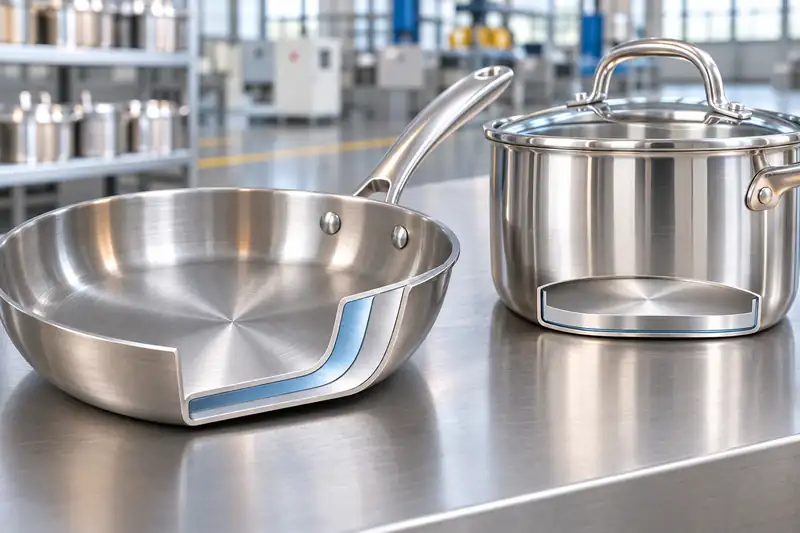
- Tri-ply runs a heat-spreading aluminium core up the whole wall; impact-bonded pans only have it in the base.
- Tri-ply cooks more evenly up the sides and costs roughly 30–60% more to make than an equivalent encapsulated pan.
- Both can be induction compatible when the outer layer or base cap is a magnetic grade such as 430.
Two constructions dominate stainless steel cookware: fully clad (most often tri-ply) and impact-bonded, also called encapsulated or capsule-bottom. They look similar on a product listing, but they behave differently on the hob and sit at very different cost levels.
How each construction is made
Tri-ply clad starts as a bonded sheet: an inner layer of 304 or 18/10, a core of aluminium, and an outer layer of 430 magnetic stainless. That sandwich is deep-drawn into the final shape, so the aluminium core runs from the base all the way up the walls.
Impact-bonded cookware starts as a single-layer stainless body. A disc of aluminium (sometimes copper-coated) is capped with a stainless plate and forged onto the base under very high pressure. Only the base carries the heat-spreading layer.
Performance differences that customers notice
- Even heating: tri-ply heats the walls as well as the base, which matters for sauces, braises and sauté pans. Encapsulated pans can scorch at the wall edge on gas.
- Responsiveness: thin tri-ply reacts quickly to heat changes; thick encapsulated bases hold heat longer, which suits stock pots.
- Weight: a tri-ply frying pan is lighter for its stiffness; encapsulated bases add weight at the bottom.
- Induction: both work when the outer surface is magnetic. Check the effective diameter of the magnetic area — small capsules on large pots can trigger “no pan” errors on some hobs.
Cost and where each fits
Clad sheet is more expensive and wastes more material during drawing, so a tri-ply set usually costs significantly more than an encapsulated set of the same piece count. In our programs we typically see:
| Program | Usual construction |
|---|---|
| Supermarket promotion, starter sets | Impact-bonded, 201 or 304 body |
| Mid-range retail, Amazon best-seller sets | Impact-bonded 304 or entry tri-ply |
| Premium retail, chef-branded lines | Tri-ply or 5-ply, 18/10 interior |
| Commercial stock pots | Thick encapsulated base for heat retention |
What to put in your specification
- Layer structure and thickness of each layer (for example 0.4 / 1.6 / 0.4 mm).
- Base disc diameter and thickness for encapsulated items.
- Interior grade and polish (satin, mirror, honeycomb texture).
- Induction test on your target market’s common hob models.
- Warping test: heat empty to a set temperature and quench, then measure base flatness.
Hybrid and honeycomb surfaces
Hybrid pans add a raised stainless honeycomb over a nonstick coating on a tri-ply body. They market well, but ask for abrasion test data and check that the coating system is PFAS-free if you sell into states with PFAS cookware restrictions.
Frequently asked questions
Is tri-ply cookware worth the extra cost?
For pans that cook with the sides — sauté pans, saucepans, woks — tri-ply heats more evenly and is lighter. For stock pots, an encapsulated base performs well at a lower cost.
Does impact-bonded cookware work on induction?
Yes, provided the base cap is a magnetic stainless such as 430 and the magnetic area is large enough for the hob to detect.