Key takeaways
- Lock the specification sheet before samples, not after — it is your quality contract.
- Budget 7–15 days for samples and 30–45 days for mass production on most kitchenware.
- Book third-party inspection (AQL) before the balance payment, not after the goods have sailed.
Launching a private-label kitchenware line is less about finding a factory and more about running a disciplined process. This is the checklist we use with first-time and experienced buyers alike.
1. Write a one-page brief
Target retail price, sales channel, destination market, monthly volume estimate and two or three reference products. This lets the factory propose constructions that hit your margin instead of quoting blindly.
2. Build the specification sheet
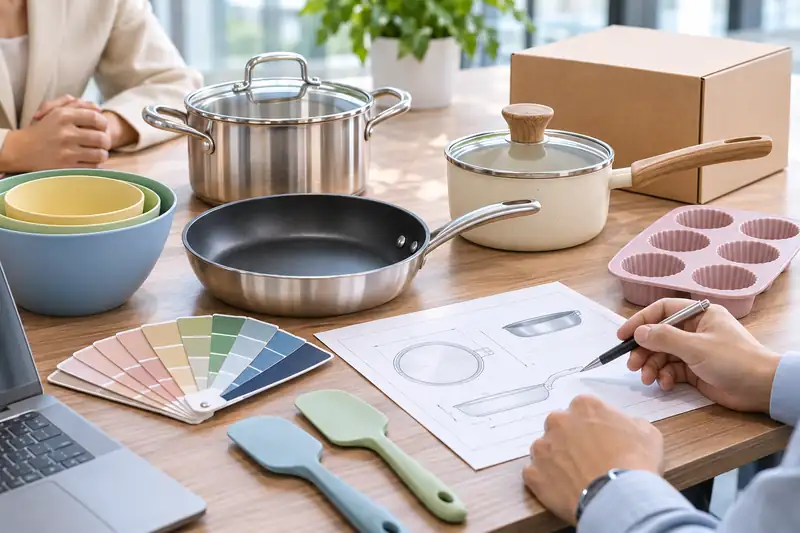
Materials and grades per component, thicknesses, sizes, finishes, colours (Pantone), logo method and position, and accessories. Attach drawings or annotated photos.
3. Confirm compliance requirements early
FDA or LFGB food contact, PFAS restrictions for nonstick, Proposition 65 warnings for California, and marketplace-specific requirements. Testing scope affects both cost and timeline.
4. Approve pre-production samples
Expect 7–15 days for samples from existing tooling and longer if new molds are needed. Approve a “golden sample” and keep a sealed counterpart at the factory.
5. Agree on MOQ, price and terms
MOQ depends on the product and customisation depth. Stock items with a logo can start low; fully custom colours, molds or printed boxes need higher volumes. A typical structure is 30% deposit and 70% against inspection or bill of lading.
6. Finalise packaging and labeling
Colour box or mail-order carton, barcode and FNSKU labels, warning labels, country-of-origin marking and carton markings. For Amazon FBA, design cartons to the current size and weight limits.
7. Production and in-line checks
Mass production typically runs 30–45 days. Ask for photos at key milestones: material arrival, forming, polishing, assembly and packing.
8. Pre-shipment inspection
Inspect to an AQL plan (for example General Level II, AQL 2.5 major / 4.0 minor) against the golden sample, including function tests such as induction, lid fit, whistle and drop tests.
9. Shipping and documents
Agree on Incoterms (FOB Shanghai or Ningbo is common), and make sure the commercial invoice, packing list and test reports match your customs and marketplace needs.
Frequently asked questions
What is a typical MOQ for private-label cookware?
It depends on the item and customisation. Stock items with a logo can start from a few hundred pieces, while custom colours, molds and printed packaging typically require 500 to 3,000 pieces per item.
How long does private-label kitchenware production take?
Allow 7–15 days for samples from existing tooling and 30–45 days for mass production, plus transit time.